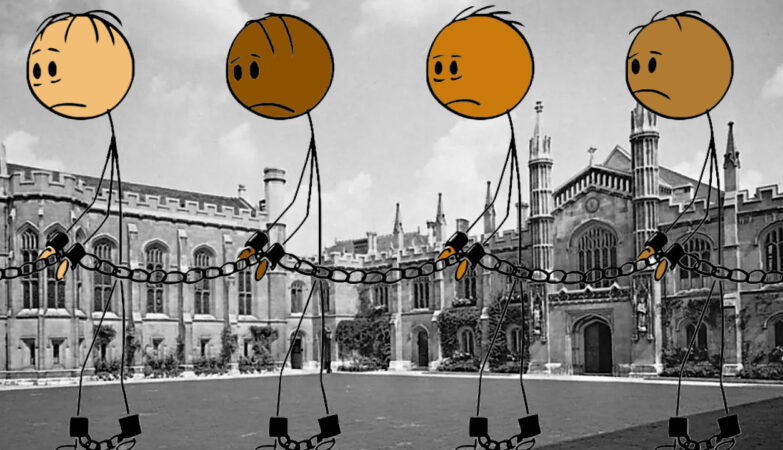

In the olden days, grifters used to be known as fraudsters who traveled from town to town committing fraud. Snake oil salesman and the like.
But times have changed. Grifting has shifted from sales to politics. From the personalities of Jordan Peterson who has pivoted his stances from the left to right in an attempt to appeal to a growing viewership to YouTube commentators and other content creators such as Alex Jones, Andrew Schultz, and Theo Von who will say just about anything for constant attention. After all, that is how they get paid.
This is especially prevalent with right-wingers.
Ad revenue is awarded to the most popular, not the most honest.
In fact, it pays so well that it’s now a multibillion-dollar industry, and it’s steering our political discourse off a cliff.
These individuals exist in various spheres of life, sometimes under different names, depending on the context. When it comes to critics of popular media, a grifter is someone who pretends to offer sincere commentary or critique but is primarily motivated by personal gain.
Often, these individuals fail to provide an in-depth examination of the work they are supposed to be critiquing. Instead, they’ll cherry-pick instances to suit a narrative, all the while positioning themselves as some form of brave objective truth teller.
In this day and age where most conversations often carry a political undertone. Not that this phenomenon is new, albeit it seems our perception of it is that the current climate is hypersensitive. There has been an emergence of bad faith and grifter critiques that aim to capitalize on, often with polarising opinions.
How Con Artists Succeed
The fascination with con artists is deeply ingrained in our culture. From movies that romanticize their exploits to real-life stories that captivate audiences, the grifter’s lifestyle appears glamorous and adventurous. However, beneath the surface lies a dark reality of deceit and manipulation.
Con artists thrive on the thrill of deception. Their charm and charisma can disarm even the most skeptical individuals. This allure is a potent weapon, allowing them to manipulate their victims into a false sense of security. The excitement of a high-stakes game, where the stakes are often someone else’s financial security, is intoxicating for both the con artist and their target.
The Types of Grifters
Let’s take a look at some common grifts you have probably seen yourself while browsing your feed on YouTube or TikTok.
The “I’m just asking questions” Guy
Asking questions is usually good. Asking good questions is better. Asking questions that feign innocence while carefully manipulating the narrative is wildly profitable. The “I’m just asking questions” guy is the archetype who has perfected the art of influence while denying they’re influencing anyone. They’ve built massive platforms by claiming to “just have conversations” – no agenda, just wide-eyed curiosity.
Please. Listen closely to those questions. Notice how they only point in one direction, mysteriously failing to interrogate the other side of the argument. Observe how the mainstream expert gets the full treatment – credentials questioned, motives doubted. Meanwhile, conspiracy theorists, fringe figures, and the lunatic who thinks chemtrails are making the frogs gay gets the chin stroke and head nod, followed by another softball.
Sometimes this is a genuine service – experts should face tough questions the mainstream media won’t ask. The problems come when the rigor is selective, when one side gets forensic interrogation and the other gets friendly chatter.
When challenged about amplifying misinformation, there’s always the retreat: “I’m just a comedian” or “I’m just asking questions”. But when their endorsement shifts political races, suddenly they’re an “important voice”. The mantle of authority gets picked up and discarded as needed.
It works brilliantly because the audience gets permission to believe what they’ve already decided is true. This is a subtle form of confirmation bias because it comes packaged in the language of “no agenda” and “just asking questions”. What makes it dangerous is that genuine inquiry gets tainted by association. When someone actually asks difficult questions in good faith, they’re now viewed with suspicion. Rigorous questioning of the climate-change denier is now associated with “the regime” rather than a search for the truth. Truly intellectually honest interrogators will cross-examine both the climate sceptic and the climate zealot equally.
The Heterodox Academic
Academics are strange creatures. Some are brilliant, have vast intellectual curiosity and a generous spirit. Others are bitter, envious and stupid about everything except one tiny area of human knowledge, about which they have god-like mastery. The heterodox academic sits uneasily between these extremes, and we often first hear about them following a controversy or public disagreement with institutional orthodoxy. This becomes the origin story for a new career outside traditional institutions.
Thrust into the limelight, their expertise tends to broaden suddenly. The biologist becomes an expert on vaccine policy. The psychologist becomes an authority on climate science. Having established the brand of “credentialled person willing to challenge consensus”, the heterodox academic will attract audiences who will accept their authority on virtually any subject. This is dangerous because humans are quick to deceive themselves in the face of flattery and the heterodox academic is the most human in his class.
Real intellectual heterodoxy requires rigorous argument and a willingness to be proven wrong. Performative heterodoxy requires only the appearance of courage and an audience hungry to distrust expertise. The grifting academic, fresh from controversy and shunned from the academy, will excel in the latter – often making claims with an unearned authority that can cause harm.
The worst of them never admit error. Every setback becomes proof of conspiracy. Every criticism is evidence of suppression. They’ve discovered you can be wrong about everything as long as you’re wrong in ways that validate your audience’s suspicions about institutions.
The Revolutionary Brand Manager
There’s something comical about the self-described communist busily planning the economy via the notes app on their iPhone. Actually, not planning the economy – that would at least make some concession to their professed ideology. What they’re really doing is building careers on anticapitalism with a gift for capitalism that would make Milton Friedman blush. The best operators in this field make revolutionary zeal into a designer aesthetic while managing their social media presence with the sophistication of a Fortune 500 marketing agency.
The routine is fairly consistent. First, rail against corporations from a hipster cafe in Kensington using a MacBook Air. That’s breakfast. Later, appear on Sky News to rail against corporate media. Evening times are for serious writing, perhaps polishing the first draft of their manifesto for audiences who’ll never experience anything more revolutionary than buying a pumpkin spice latte.
What’s striking isn’t the hypocrisy – everyone’s a hypocrite about something. It’s the complete absence of cognitive dissonance. Genuine radicals at least struggle with the compromises required to survive under capitalism. The revolutionary brand manager has no such qualms because the “revolution” is really just a brand differentiation strategy that gets them onto media panels and speaking circuits.
While it’s true that revolutionaries have often come from privileged backgrounds — Lenin was upper middle class, for example – what they did not enjoy was the same insulation from consequences. The modern revolutionary brand manager — book deal secured, regular slot on mainstream news media and a growing property portfolio — is revolting, certainly, but not in the way they think.
The Identity-Politics Entrepreneur
Perhaps no political grifter is as instantly recognizable as the one who discovered that demographic credentials can be monetized if you tell the right audience what it wants to hear.
The formula is simple and repeatable: “As a [minority identity], I can tell you that [issue] isn’t actually the problem they claim it is”. Identity provides the authority. Contrarianism provides the income. It’s a perfect marriage.
On the right, there’s a lucrative market for minority voices willing to tell conservative audiences that racism or sexism isn’t really a problem – that the real victims are actually the people being accused of discrimination. On the left, there’s a demand for people who’ll weaponize their identity to police ideological boundaries and excommunicate heretics. Then there’s the white liberal who makes a career castigating whiteness, monetizing the guilt and moral vanity of other white people desperate to prove they’re “one of the good ones”.
The pattern is consistent across demographics: they never meaningfully challenge the audiences that platform them. They save their harshest criticism for the communities they claim to represent. The traditional grift was exploiting your community for personal gain. This is more efficient in that it exploits your identity to gain access to audiences that will pay you to criticize your community.
What makes this particularly corrosive is how it poisons genuine discussions about discrimination. When someone raises legitimate concerns about racism or sexism, they’re now competing with a marketplace of identity entrepreneurs who’ve already told everyone what they want to hear. The grifters don’t just profit from division – they ensure the problems they claim to address never get solved, because solving them would end the revenue stream.
The Far-Right Edgelord
Who would have thought that at the dawn of the internet, saying unsayable things would one day be a viable business model? Yet here we are, a few decades later, watching young men born in this century turning the horrors of the last into clicks. These are the edgelords – essentially right-wing engagement farmers who discovered that Holocaust jokes and “ironic” fascism play well with an audience that equates provocation with profundity.
Ironically, they often present themselves as serious thinkers, brave and fearless. But they’re not speaking truth to power or taking on a cruel authoritarian state. They’re just saying vile things designed to provoke outrage, knowing that this feeds the algorithm, which in turn generates revenue.
The defining feature is escalation. Each statement must outdo the last because the audience develops tolerance. What starts as “just asking questions” about historical events ends with openly praising “misunderstood” dictators.
The business model works by cultivating an audience of alienated young men (it’s nearly always men), telling them their grievances are legitimate, pointing at an enemy and then selling them the identity of “fearless truth-teller”. What the followers are actually buying is the feeling of being in on a secret that the “normies” are too scared to hear.
We can’t just dismiss this as the sad and pathetic hobby of naive kids following a cynical manipulator. Yes, the average antisemitic ghoul might look like he was grown in a lab from the least impressive part of Hitler’s anatomy. But mockery only works so far, because bubbling away under the grift is a growing army of demoralized young men looking for someone to blame. And that someone, increasingly, is Jewish, or black, or Muslim, or Latino. It doesn’t really matter as long as it’s not their own fault.
Conclusion
Grifting is an American tradition that transcends socioeconomic boundaries and political affiliations. It manifests in various forms, from outright scams to ideological manipulation. For instance, the Democratic coalition has raised substantial funds from voters, yet over 99% of these funds often go to executives and major sponsors rather than grassroots initiatives.
The political grifter emerges in a system that rewards performance over principle, and confidence over intellectual honesty. The attention economy isn’t interested in what’s “right”, only in what triggers an emotional response – especially outrage and moral righteousness. Playing on identity and dialling up the contrarianism are marketing strategies to sell you a product.
The problem is that the public keeps buying it. Too many of us are willing and eager customers paying in clicks and shares and chasing dopamine as we raise our digital pitchforks to pile on the enemy.
The very best political grifters understand all this better than we do – that in our craving for conviction, we become addicted to people who sound certain when we no longer are.
- https://www.gadflynotes.com/p/five-types-of-political-grifter-ruining
- https://squatterlockout.medium.com/the-rise-of-grifters-understanding-modern-scams-and-their-impact-a373a5781aa9
- https://globalindiannetwork.com/bad-faith-criticism-in-popular-media/
- https://galaxy.ai/youtube-summarizer/the-rise-of-right-wing-grifters-analyzing-the-new-wave-of-political-influence-7AOYn5xX9QE

- Pam Bondi and Kash Patel Are Protecting Elite Pedophiles - February 12, 2026
- Why the Dead Internet Theory Is True - February 11, 2026
- Why Republicans Will Lose the 2026 Midterms - February 8, 2026