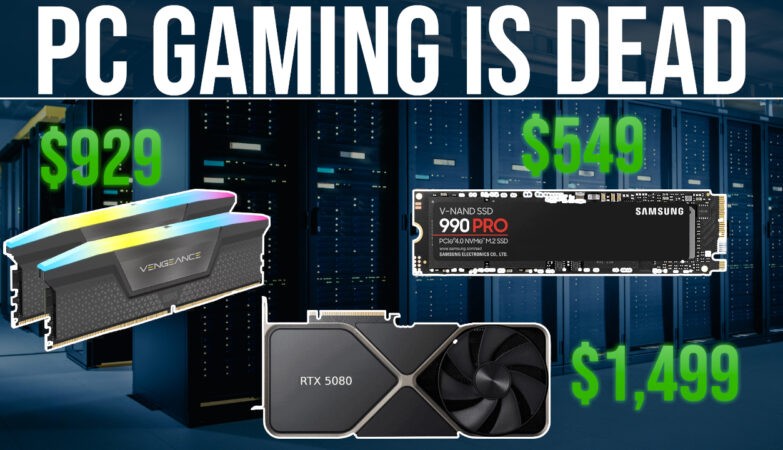
As if 2026 couldn’t start off any worse when it comes to pricing with unaffordable houses, unaffordable rent, unaffordable energy bills, and unaffordable groceries, we now have unaffordable computers.
Thinking that you could escape from the collapse of modern society by gaming away your hopes and dreams? Nope, you can’t afford to do that either anymore.
Since the beginning of last year, CPU prices have increased around 25%. SSD prices have increased by nearly double and RAM prices have tripled. The final nail in the coffin is GPU prices once again shooting up and is only getting worse.
For the first time in.. as long as I have been alive, all four major components of PC builds are experiencing shortages and inflation.
While AI is the main culprit here, I’d like to dive a little deeper in to all of the reasons for these insane price hikes which are succeeding at killing the PC gaming industry.
Taxes Are Too Damn High
In many low and middle-income countries, the situation is even worse than here in the states. Import duties, VAT, and shipping are added on top of already inflated wholesale prices. Local sellers also need to cover rent, salaries, and profit margins.
When everything is added, a graphics card that costs $600 in the United States can easily reach over $800 or more, and a mid‑tier build can go well above $1,500.
At the same time, average monthly wages in these regions are often below $500, meaning a single PC part can equal several months of income. That gap makes PC gaming impossible for most households, for example in India.
As a result, many players stay on very old hardware, share PCs in internet cafes, or simply drop out of the platform and choose cheaper options.
AI Is Ruining Everything
The same GPUs used for 4K gaming are also the muscles behind large language models and other AI services. Cloud providers and big firms now buy thousands of cards at once.
Reports show that high‑end GPUs often sell 50%–100% above MSRP, and even mid‑range cards cost far more than in the pre‑pandemic years.
Powerful desktop memory supply is being wiped out. With AI systems gobbling up so much of it, the cost of these chips is climbing. Even a small bump – just a few percentages – can quickly make phones, laptops, and other gadgets more expensive.
For a normal gamer, this looks like fewer cards on shelves, less discounting, and constant pressure to pay more for the same level of performance.
DRAM and NAND Flash Shortage
No components have been hit harder than memory (DRAM) and storage (NAND Flash).
AI accelerators depend on High Bandwidth Memory—a product dramatically more complex and wafer-intensive than consumer DDR5. The largest memory manufacturers like Micron, SK Hynix, and Samsung are prioritizing HBM because demand and margins are soaring.
Contract DRAM prices have surged 70%–170% year over year which has had an immediate impact on system RAM pricing, especially 32GB and 64GB kits.
Large quantities of NAND are now diverted to data centers, tightening supply for consumer NVMe SSDs—particularly high-volume models like 2TB and 4TB Gen4/Gen5 drives.
GDDR Shortage
Graphics cards are also feeling the effect—not from GPU silicon shortages, but from the GDDR memory each card relies on.
GDDR6/GDDR7 production depends on the same strained DRAM supply chain. Even small increases in VRAM pricing ripple into GPU MSRP after manufacturer margins.
Some industry insiders even believe OEMs may reduce or discontinue low-margin, budget-tier GPUs that use large VRAM capacities, because those models become unprofitable during a DRAM surge.
Prebuilt Price Increases
Do It Yourself (DIY) builders feel these increases immediately but major OEMs are now following.
CyberPowerPC implemented a price adjustment on December 7th.
Dell implemented 15–20% increases across desktops and laptops in mid-December.
Lenovo notified business clients that all quotes expired last month on January 1st, signaling a new pricing baseline for the new year.
Greed Is Profitable
The incentive to make affordable PC parts for consumers is pretty low these days. Micron/Crucial straight up issued a statement in December telling the public that we just don’t make them enough money compared to commercial or government customers who want those juicy AI data centers like Google and Raytheon.
NVIDIA also released numbers showing how they make nearly ten times more profit from AI than gaming.
Not only that, scalpers are a dime a dozen and almost every seller across the board has increased prices on older hardware being sold online at storefronts like Amazon, eBay, and Newegg.
People just can’t resist taking advantage of others, even though it’s inevitably a race to the bottom. Greed is truly one of the worst human traits and those of us who consciously resist it are quickly becoming the minority if we aren’t already.
Surviving the Onslaught
Market reports suggest GPU prices will likely stay high until new factories and supply lines catch up, which could take until 2026 or 2027.
As far as memory and storage prices go, with manufacturers like Crucial dropping out of the consumer market after years of providing some of the most affordable and reliable SSDs and contracts for other manufacturers not ending until 2028, it could likely be 2029 or even 2030 before we see RAM prices becoming affordable again.
Next‑gen consoles, on the other hand, are expected to keep the same basic model, custom chips, negotiated component prices, and a willingness to accept hardware losses in exchange for long‑term software revenue.
That mix usually gives each new generation a noticeable leap in power for a fixed or only slightly higher launch price. For budget‑limited players, that can be a good opportunity.
In this context, rushing to buy an overpriced GPU today might not be wise, especially in countries where salaries lag far behind electronics inflation.
While waiting, some players are turning to refurbished PCs, older GPUs that dropped in price, or cloud gaming where internet speeds allow it. These options stretch existing hardware a bit longer.
Although personally I am not a supporter of cloud gaming as it gives companies another reason to force us in to subscription models.
Many of you already know the quote by Danish politician Ida Auken and later the World Economic Forum:
“You will own nothing and be happy”
Others combine a cheaper console for new releases with a low‑power PC or laptop for work and indie titles, instead of chasing a single machine that does everything.
For many people outside high-income countries, the “dream build” PC is now out of reach, not because they love games less, but because global hardware prices moved into an entirely new economic universe that only the upper class or wealthy can afford.
In that world, consoles, older GPUs, and patience can be smarter than debt. Waiting for the next console wave, or for GPU supply to finally calm down, may feel boring, but it often protects both your frame rate and your bank account.

- Pam Bondi and Kash Patel Are Protecting Elite Pedophiles - February 12, 2026
- Why the Dead Internet Theory Is True - February 11, 2026
- Why Republicans Will Lose the 2026 Midterms - February 8, 2026