I’m old enough to remember a time when streaming was revolutionary.
Gone were the days of needing to watch endless ads on cable and satellite TV or finding a reliable blank DVD for bootlegging a movie downloaded from LimeWire.
Media production companies hit a gold mine. They needed a way to stop piracy since law enforcement couldn’t and neither could those hilarious anti-piracy TV ads.
Streaming did just that.
By mid-2011 traffic for Netflix had dominated BitTorrent, one of, if not the largest file sharing sites at the time. This proved that most people were actually interested in the convenience and easy obtainability of content rather than intentionally “stealing” it.
Founder of Valve and Steam, Gabe Newell once made the statement,
“One thing that we have learned is that piracy is not a pricing issue. It’s a service issue,”
He was correct and Netflix proved that when given an easy and affordable legal option, the vast majority would choose this option over piracy.
It didn’t take long for other video streaming services to pop up such as Hulu and Crackle.
Music followed suit with services like Pandora, Spotify, and Apple Music. While artists received less revenue per song play compared to physical media they had sold, the amount of plays and sales increased dramatically. Not only that, with even larger fanbases, increased sales of merch would follow.
Most music artists were okay with this except for that one guy from Metallica.
For a while, it was pretty great since there were just a few big players in each industry that had access to a large amount of streaming rights for most of the major networks and studios.
We had access to virtually every movie in existence and almost every song that was ever produced, minus mixtapes and unofficial records with just one or two modestly priced subscriptions.
The Decline of Streaming Services
Unfortunately, the greed of every major media company began to erode the quality of these services.
Disney, Warner Bros., Paramount, Apple, Amazon, Sony, Discovery, etc. all built their own “exclusive” platforms. Each saw streaming not as a shared ecosystem but as a fortress to be defended with exclusive content and licensing walls.
The result? A hydra of subscription services.
For you and me, this means the same series your friends recommend might be scattered across five different services, each with their own pricing tiers, apps, and fine-print conditions.
To keep up with the “big six” alone, American households now face an annual bill upwards of $1,500 — and that doesn’t even capture niche services. It’s hardly surprising half of consumers report “subscription fatigue.” Culture fragmented into little cubbyholes, locked away behind velvet ropes.
And fragmentation was just the beginning. Once the walls were built, the corporations started squeezing.
The Greed Strategy
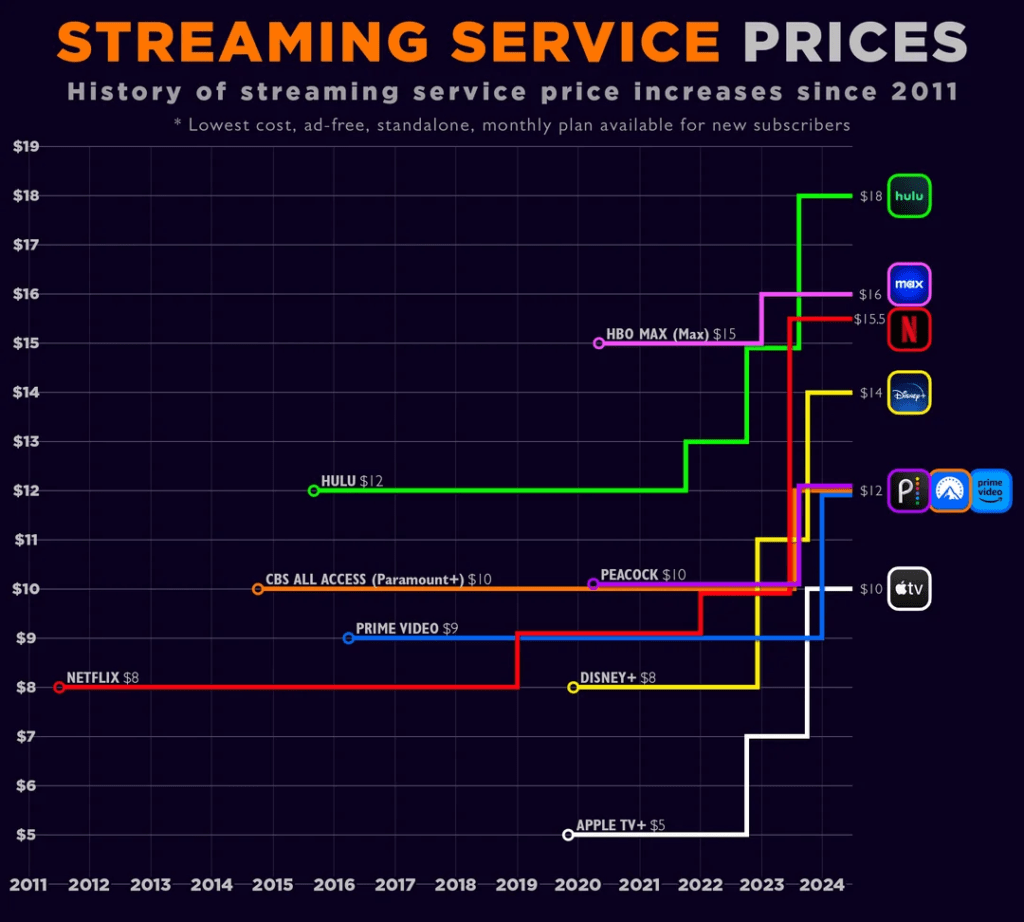
After dividing the market, streaming platforms began reaching for the real prize: extraction.
Prices rose sharply. Netflix Premium jumped from $15.99 to $19.99 by 2022, completely replacing their no-ad basic tier subscription with a free, ad-filled one. Disney+ following suit, hiking its price from $6.99 at launch in 2020 to $18.99 for ad-free viewing in 2025.
These rises often far outpaced inflation, gradually transforming “affordable entertainment” into a luxury stack with a four-digit annual price tag.
Sharing — which used to be part of the appeal — was criminalized. In 2023 Netflix began cracking down on password sharing, framing it as lost revenue. Disney+ quickly followed in 2024. Suddenly, grandparents living in a different household or siblings away at university became revenue leaks needing to be cut off.
Customers who thought of family as… well, family, were now told they were stealing.
And then came ads. Not on “free with ads” tiers, but on paid subscriptions. Paying $12 a month and still being forced to sit through ads is less innovation and more insult. Platforms sold us convenience, then turned around to degrade it once enough of us were hooked.
Finally, perhaps the most egregious violation: content deletion.
Sony attempted to strip over 1,300 seasons of Discovery shows, including Mythbusters, from PlayStation users who had already paid for digital access. The outcry was intense enough to force a reversal, but the precedent was clear. Our purchases aren’t purchases at all—they’re licenses at the mercy of corporate whim.
Buying is renting. Ownership is an illusion.
AI Artists
The greed didn’t stop there. Streaming services realized that they could skip out on paying artists altogether by introducing fake songs made by fake bands made by AI to their unwitting subscribers. Just try looking for a legitimate jazz band on Spotify.
It’s almost impossible if you don’t actually know the name of real human artists. You’ll be flooded with results from AI slop. Even worse, they don’t all sound too bad, just very generic.
Return of the Pirates
Faced with these conditions, people responded the only way people ever do when systems become exploitative: they routed around them. Piracy surged again. Global visits to piracy sites rose from 130 billion in 2020 to 216 billion by 2024 — an increase that no amount of “educational campaigns” about morality can explain away.
Piracy today doesn’t thrive because people suddenly became less ethical. It thrives because, ironically, it once again offers the superior service:
- Everything is in one place
- It costs nothing, versus $1,500+ a year
- Files don’t vanish when some licensing contract expires
- No ads, no regional restrictions, no arbitrary quality caps
In fact, in many ways piracy has become an inadvertent global archive. Old series, obscure films, niche cultural products that platforms delete to save money — what survives often does so because pirates kept it alive. They’ve become digital librarians, preserving our culture in defiance of corporate amnesia.
If Buying Isn’t Owning, Piracy Isn’t Stealing
When Sony defended its move by claiming users only purchased “temporary licenses,” it exposed a truth it would rather keep hidden: we don’t own what we buy. And if we don’t own it, piracy stops being theft. It becomes parity.
At that point, piracy feels far less like freeloading and far more like civil disobedience. Copying media is reframed as preservation, as resistance, as saying:
“I won’t let you erase history because it doesn’t fit into this quarter’s balance sheet.” “I won’t accept a system where spending $1,500 a year still doesn’t guarantee cultural access.” “I refuse to pay for the privilege of being treated like a revenue leak.”
When the legal market denies rights, parallel systems emerge. They might call it theft. But increasingly, it looks like moral obligation.
The Gaming Industry Is No Different
The gaming world illustrates the exact same split in philosophy. Western AAA publishers have turned to microtransactions, loot boxes, and aggressive monetization. The results are layoffs, closures, and disillusioned players.
Compare that with independents: indie games grew explosively, claiming 48% of Steam’s revenue in 2024 compared to 31% only a year earlier. Why? Because people recognized fair value when they saw it.
Meanwhile, Asia, and especially China, is experiencing a boom. Tencent and NetEase dominate at scale, while developers like miHoYo (Genshin Impact, Honkai: Star Rail) build global hits. They combine world-class quality with player engagement models that—while not free of monetization — at least deliver sustained value and strong community ties.
Five out of eight major Japanese studios hit all-time share price highs in 2024; Chinese developers are riding a similar wave. It isn’t that gamers hate paying. They hate being scammed.
Consumers reward respect. They punish exploitation.
The Answer Is Simple
The solution has not changed since 2011: treat customers with dignity. Give us a few platforms that are fairly priced. Guarantee that our purchases cannot vanish at the whim of a licensing change. Stop stuffing ads into paid tiers. Don’t criminalize families who share accounts.
All of this is technically possible, right now. What’s missing is restraint — the courage to take reasonable profits rather than squeeze until the last drop.
Conclusion
Piracy is the natural backlash of a broken system. Each price hike, ad-insertion, and “content removal” is another reminder that corporations see culture as disposable and customers as cattle.
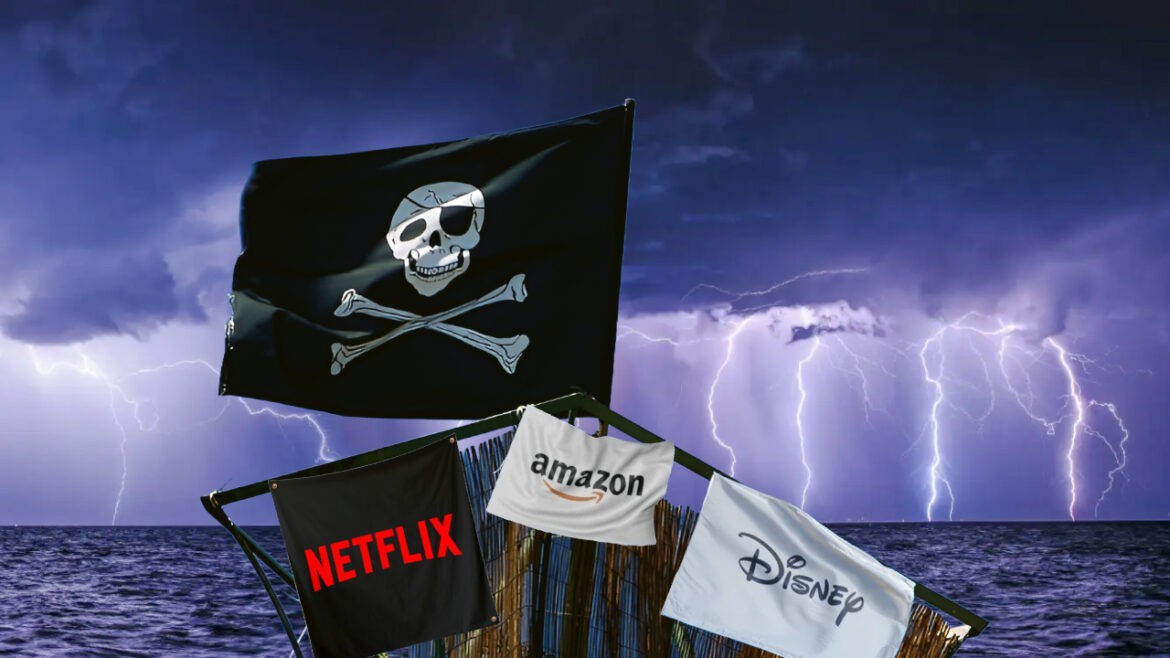
We could have had a thriving ecosystem that balanced creator pay with consumer access. Instead, we got a cautionary tale of how greed cannibalizes trust. And so, each time they overreach, another pirate ship sets sail.
If companies won’t preserve our access, maybe it really is our duty to fly the black flag.
With that being said, here is a list of some popular resources for pirating media such as movies, shows, and music.
- https://vanderkleijn.net/posts/international-speak-like-a-pirate-day/
- https://wisdomised.com/entertainment/how-greed-in-streaming-revived-piracy/
- https://highoncinemaa.com/features/piracy-is-back-again-as-streaming-services-get-greedier-and-more-exclusive-than-inclusive/54955/
- https://synnistry.com/the-greed-that-resurrected-piracy

- Pam Bondi and Kash Patel Are Protecting Elite Pedophiles - February 12, 2026
- Why the Dead Internet Theory Is True - February 11, 2026
- Why Republicans Will Lose the 2026 Midterms - February 8, 2026